


Selecting the appropriate ball diameter for a thrust ball bearing is a crucial decision that can significantly impact the performance, durability, and efficiency of the bearing. As a reputable thrust ball bearing supplier, we understand the complexities involved in this process and are here to guide you through it.
Understanding the Basics of Thrust Ball Bearings
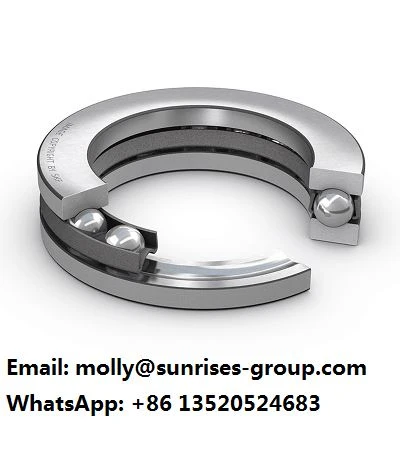
Thrust ball bearings are designed to handle axial loads, which act parallel to the bearing axis. They consist of two washers, one stationary and one rotating, and a set of balls that roll between them. The ball diameter is one of the most critical factors that determine the bearing's load - carrying capacity, speed, and friction characteristics.
Factors Influencing Ball Diameter Selection
Load Requirements
The most important factor in determining the ball diameter is the axial load that the bearing will need to support. Generally, larger ball diameters can carry higher loads. When a large axial load is applied, the pressure distribution on the balls is more evenly spread with larger balls. For instance, in heavy - machinery applications such as large presses or crushers, where high axial loads are common, bearings with larger ball diameters are preferred. Our 51406 - Thrust Ball Bearing Single Direction is designed with an appropriate ball diameter to handle relatively high axial loads, making it suitable for industrial equipment under heavy stress.
Speed of Operation
The speed at which the bearing operates also plays a significant role in ball diameter selection. Smaller balls have less rotational inertia, which allows them to accelerate and decelerate more quickly. This is advantageous in high - speed applications, as it reduces the heat generated due to friction. On the other hand, larger balls may not be able to rotate as fast without excessive wear and heat generation. For high - speed spindles in machine tools, bearings with smaller ball diameters are often a better choice. Our bearings with optimized small - ball designs can meet the requirements of high - speed applications, ensuring smooth and reliable operation.
Space Constraints
The available space within the bearing housing is another practical consideration. In some applications, there may be limited space for the bearing. In such cases, a smaller ball diameter may be necessary to fit the bearing into the available space. However, it's important to note that reducing the ball diameter may also reduce the load - carrying capacity of the bearing. Therefore, a careful balance must be struck between space requirements and load - handling capabilities.
Precision Requirements
In applications where high precision is required, such as in aerospace or medical equipment, the ball diameter tolerance becomes crucial. Smaller ball diameters can sometimes allow for more precise manufacturing and better control of the bearing's running accuracy. Our 51240 - MP - Thrust Deep Groove Ball Bearings are manufactured to high precision standards, with carefully selected ball diameters to ensure accurate and stable performance.
Calculation and Selection Process
Load Rating Calculation
To determine the appropriate ball diameter based on load requirements, a load rating calculation is essential. Manufacturers provide load rating data for their bearings, which includes dynamic and static load ratings. By calculating the equivalent axial load acting on the bearing in the application, you can compare it with the load ratings of different bearings with various ball diameters. The bearing should have a load rating that exceeds the calculated equivalent axial load to ensure reliable operation.
Using Bearing Selection Software
Many modern bearing suppliers offer bearing selection software that takes into account various factors such as load, speed, and operating conditions to recommend the most suitable bearing, including the appropriate ball diameter. These software tools use complex algorithms based on engineering principles and experimental data to provide accurate selection results. Our company also provides access to such software to help our customers make informed decisions.

Consulting with Bearing Experts
If you are still unsure about the ball diameter selection, it is always advisable to consult with bearing experts. As a thrust ball bearing supplier, we have a team of experienced engineers who can provide personalized advice based on your specific application requirements. We can analyze your operating conditions, load profiles, and other relevant factors to recommend the best bearing with the appropriate ball diameter for your needs.
Importance of Quality in Ball Diameter Selection
Using a bearing with an appropriate ball diameter is not enough; the quality of the balls themselves is also crucial. High - quality balls are made from materials with excellent hardness, wear resistance, and fatigue strength. They are manufactured to strict dimensional tolerances, ensuring consistent performance. At our company, we source only the highest - quality materials for our thrust ball bearings and use advanced manufacturing processes to produce balls with precise diameters. This guarantees the long - term reliability and performance of our bearings.
Case Studies
Let's consider two different cases to illustrate the importance of proper ball diameter selection.
Case 1: Industrial Press
In an industrial press application, a large axial load is continuously applied. An initial selection of a bearing with a small ball diameter led to premature failure due to excessive ball deformation and increased wear. After consulting with our experts, a new bearing with a larger ball diameter was selected, specifically our 51406 - Thrust Ball Bearing Single Direction. This bearing was able to distribute the load more evenly across the balls, resulting in significantly improved bearing life and reduced maintenance costs.
Case 2: High - Speed Spindle
In a high - speed spindle application, a bearing with a large ball diameter was initially used. This caused excessive heat generation and vibration, leading to poor machining accuracy. By switching to a bearing with a smaller ball diameter optimized for high - speed operation, the spindle's performance was greatly enhanced. The reduced rotational inertia of the smaller balls allowed for smoother and more precise operation at high speeds.
Conclusion
Selecting the appropriate ball diameter for a thrust ball bearing is a multi - faceted process that requires careful consideration of load requirements, speed of operation, space constraints, and precision requirements. As a trusted thrust ball bearing supplier, we are committed to helping our customers make the right choices. Our extensive range of bearings, including the 51272 F Thrust Ball Bearings, Single Direction, 51406 - Thrust Ball Bearing Single Direction, and 51240 - MP - Thrust Deep Groove Ball Bearings, is designed to meet a wide variety of applications.
If you are in the process of selecting a thrust ball bearing and need assistance with ball diameter selection or any other bearing - related questions, we encourage you to contact us. Our team of experts is ready to work with you to provide the best solutions for your specific needs and to assist you in purchasing the most suitable bearings for your applications.
References
- Harris, T. A. (2006). Rolling Bearing Analysis. Wiley - Interscience.
- Schoeffler, J. R. (2019). Fundamentals of Rolling Bearing Technology. Schaeffler Technologies AG & Co. KG.


