


Hey there! As a supplier of Spherical Roller Bearings, I've been in the industry long enough to know that the surface roughness of a bearing can have a huge impact on its performance. In this blog, I'm gonna break down the influence of bearing surface roughness on performance and why it matters to you.
What is Surface Roughness?
First off, let's talk about what surface roughness actually is. Surface roughness refers to the microscopic irregularities on the surface of a bearing. These irregularities can be caused by various manufacturing processes like grinding, turning, or polishing. They can be measured in terms of parameters like Ra (arithmetical mean deviation of the profile), Rz (mean height of the profile irregularities), and others.
Impact on Friction and Wear
One of the most significant ways surface roughness affects bearing performance is through friction and wear. When the surface of a bearing is rough, there are more contact points between the rolling elements and the raceways. This increased contact area leads to higher friction, which in turn generates more heat. Excessive heat can cause the lubricant to break down, reducing its effectiveness and leading to accelerated wear of the bearing components.
For example, if you have a NTN 22326UAVS2 - Spherical Roller Bearing For Shaker Screen with a rough surface, the friction between the rollers and the raceways will be higher. This can result in premature wear of the bearing, reducing its service life and increasing the likelihood of failure.
On the other hand, a smoother surface reduces the number of contact points and the overall friction. This means less heat is generated, and the lubricant can do its job more effectively, protecting the bearing from wear and extending its lifespan.
Influence on Lubrication
Surface roughness also plays a crucial role in lubrication. A proper lubricant film is essential for reducing friction and wear in a bearing. When the surface is rough, it can disrupt the formation of a continuous lubricant film. The peaks and valleys on the surface can cause the lubricant to be squeezed out, leaving areas of direct metal-to-metal contact.
In a 241-800KYMDW73W879 Spherical Roller Bearing 8001280475, a rough surface can prevent the lubricant from forming a stable film, leading to increased friction and wear. In contrast, a smooth surface allows the lubricant to spread evenly and form a continuous film, providing better protection for the bearing.

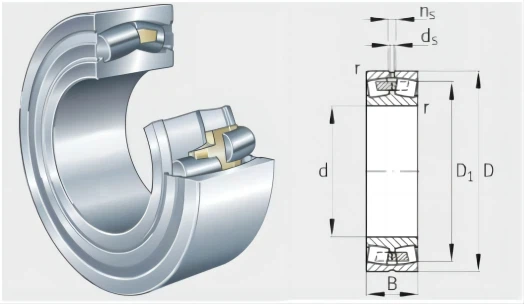
Effect on Noise and Vibration
Another aspect affected by surface roughness is noise and vibration. Rough surfaces can cause uneven contact between the rolling elements and the raceways, leading to vibrations. These vibrations can be transmitted through the machinery and result in noise. Excessive noise and vibration not only affect the working environment but can also indicate potential problems with the bearing.
For instance, in a machine using an Available 222/600-MB With Size 600x1090x280 mm - Spherical Roller Bearing, a rough bearing surface can cause the machine to produce more noise and vibrate more than normal. This can be a sign of impending bearing failure and should be addressed promptly.
Impact on Load Capacity
Surface roughness can also have an impact on the load capacity of a bearing. A rough surface can cause stress concentrations at the contact points between the rolling elements and the raceways. These stress concentrations can reduce the overall load-carrying capacity of the bearing and increase the risk of fatigue failure.
When a bearing is subjected to heavy loads, a smooth surface can distribute the load more evenly across the contact area, reducing the stress on individual points. This allows the bearing to handle higher loads without experiencing premature failure.
Importance of Controlling Surface Roughness in Manufacturing
As a Spherical Roller Bearings supplier, we understand the importance of controlling surface roughness during the manufacturing process. By using advanced manufacturing techniques and quality control measures, we can ensure that our bearings have the optimal surface roughness for their intended applications.
We carefully select the manufacturing processes and tools to achieve the desired surface finish. For example, we may use precision grinding and polishing techniques to create a smooth surface on the bearing components. We also conduct rigorous quality inspections to ensure that the surface roughness meets the required standards.
Conclusion
In conclusion, the surface roughness of a bearing has a profound influence on its performance. It affects friction, wear, lubrication, noise, vibration, and load capacity. As a customer, it's important to choose bearings with the right surface roughness for your specific application.
If you're in the market for high-quality Spherical Roller Bearings, look no further. We're here to provide you with bearings that are manufactured to the highest standards, with the optimal surface roughness for superior performance. Whether you need a NTN 22326UAVS2 - Spherical Roller Bearing For Shaker Screen, a 241-800KYMDW73W879 Spherical Roller Bearing 8001280475, or an Available 222/600-MB With Size 600x1090x280 mm - Spherical Roller Bearing, we've got you covered.
If you have any questions or want to discuss your bearing requirements, feel free to reach out. We're always happy to help you find the perfect bearings for your needs.
References
- Harris, T. A., & Kotzalas, M. N. (2007). Rolling Bearing Analysis. Wiley.
- Stachowiak, G. W., & Batchelor, A. W. (2005). Engineering Tribology. Elsevier.


