


Hey there! As a slewing bearings supplier, I often get asked about various aspects of slewing bearings. One question that pops up quite frequently is, "What is the pre - loading of slewing bearings?" Today, I'm gonna break it down for you in a way that's easy to understand.
First off, let's talk about what slewing bearings are. These are specialized bearings that can handle axial, radial, and moment loads all at once. They're used in a wide range of applications, from construction equipment like cranes and excavators to wind turbines and even some medical devices.
Now, onto pre - loading. Pre - loading in slewing bearings is like giving them a little "head start" in terms of performance. It's the process of applying an initial load to the bearing before it starts operating under its normal working conditions. This initial load can have a huge impact on how the bearing performs over its lifespan.
Why is pre - loading important?
1. Reducing play
One of the main reasons for pre - loading is to reduce play or clearance within the bearing. You know how sometimes when you move a part, there's a little bit of wiggle room? That's play. In a slewing bearing, too much play can lead to inaccurate positioning and even cause vibrations. By pre - loading the bearing, we can minimize this play, which in turn improves the overall precision of the equipment the bearing is used in. For example, in a robotic arm that needs to make very precise movements, a pre - loaded slewing bearing can ensure that the arm moves exactly where it's supposed to.
2. Increasing stiffness
Pre - loading also increases the stiffness of the slewing bearing. Stiffness is how well a bearing resists deformation under load. A stiffer bearing can handle heavier loads without flexing or bending too much. This is crucial in applications where high loads are common, such as in large construction machinery. A crane, for instance, needs to lift heavy loads safely. A pre - loaded slewing bearing can provide the necessary stiffness to support these loads without failing.
3. Improving fatigue life
Another benefit of pre - loading is that it can improve the fatigue life of the bearing. Fatigue is what happens when a material weakens over time due to repeated loading and unloading. By pre - loading the bearing, we can distribute the loads more evenly across the rolling elements and raceways. This reduces the stress concentration on certain areas, which in turn helps to prevent premature fatigue failure. So, the bearing can last longer and require less frequent replacement.
How is pre - loading achieved?
There are a few different methods to pre - load slewing bearings.
1. Axial pre - loading
This is one of the most common methods. Axial pre - loading involves applying a load along the axis of the bearing. This can be done using springs, washers, or by tightening bolts. For example, in some applications, a set of springs is placed between the bearing and its housing. When the housing is assembled, the springs compress, applying an axial load to the bearing.
2. Radial pre - loading
Radial pre - loading, on the other hand, applies a load perpendicular to the axis of the bearing. This method is often used in applications where radial forces are dominant. It can be achieved by using specially designed inner and outer rings with different diameters or by using interference fits. An interference fit is when the inner ring is slightly larger than the shaft it's mounted on, or the outer ring is slightly smaller than the housing it fits into. When the bearing is installed, this creates a radial pre - load.
3. Combined pre - loading
Sometimes, a combination of axial and radial pre - loading is used. This can provide the best of both worlds, allowing the bearing to handle a wide range of loads effectively. The specific method used depends on the application requirements and the design of the bearing itself.
Types of pre - loaded slewing bearings
At our company, we offer a variety of pre - loaded slewing bearings to meet different customer needs. For example, the YRTSM460 - Precision Slewing Axial/radial Roller Bearings is a great option for applications that require high precision and both axial and radial load - handling capabilities. This bearing is pre - loaded to ensure accurate positioning and smooth operation.

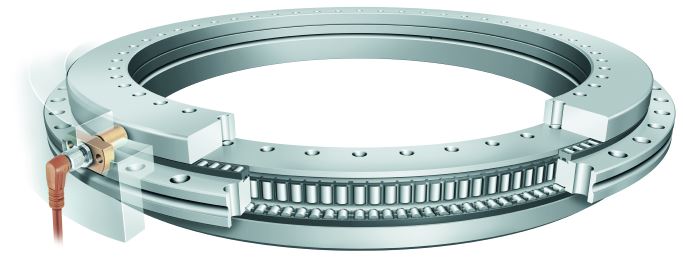
Another option is the VU360680 - ZT - Four Point Contact Bearings Without Gear Teeth, Sealed On Both Sides. These bearings are designed with four - point contact, which allows them to handle axial, radial, and moment loads. The pre - loading in these bearings helps to improve their stiffness and reduce play, making them ideal for applications where high - load capacity and precision are required.
And if you're looking for a more compact option, the VSU200414 - Four Point Contact Bearing Slewing Ring is a great choice. Despite its smaller size, it still offers excellent performance thanks to its pre - loaded design. It can handle a variety of loads and is suitable for applications where space is limited.
Factors to consider when choosing a pre - loaded slewing bearing
When it comes to selecting the right pre - loaded slewing bearing for your application, there are a few things you need to keep in mind.
1. Load requirements
First and foremost, you need to consider the loads that the bearing will be subjected to. This includes the magnitude of the axial, radial, and moment loads, as well as how these loads vary over time. Different pre - loaded bearings are designed to handle different load combinations, so it's important to choose one that can meet your specific requirements.
2. Precision requirements
How precise does your equipment need to be? If you're working on a project that requires very high precision, like a medical imaging device or a high - end CNC machine, you'll need a bearing with a high level of pre - loading to ensure accurate positioning.
3. Operating conditions
The environment in which the bearing will operate also matters. Factors such as temperature, humidity, and the presence of contaminants can all affect the performance of the bearing. For example, in a harsh outdoor environment where there's a lot of dust and dirt, you might want to choose a sealed pre - loaded bearing to protect it from these contaminants.
Conclusion
Pre - loading is a crucial aspect of slewing bearing design and performance. It can significantly improve the precision, stiffness, and fatigue life of the bearing, making it a key consideration for anyone using slewing bearings in their applications. Whether you're in the construction, manufacturing, or any other industry that relies on slewing bearings, understanding pre - loading can help you make better decisions when it comes to choosing the right bearing for your needs.
If you're interested in learning more about our pre - loaded slewing bearings or have any questions about how they can fit into your project, don't hesitate to reach out. We're here to help you find the perfect solution for your specific requirements. Let's start a conversation and see how we can work together to enhance the performance of your equipment.
References
- Harris, T. A., & Kotzalas, M. N. (2007). Rolling Bearing Analysis. Wiley.
- Stachowiak, G. W., & Batchelor, A. W. (2005). Engineering Tribology. Elsevier.


