


Hey there! As a slewing bearings supplier, I've been getting a lot of questions lately about the relationship between stiffness and precision of slewing bearings. So, I thought I'd take a moment to break it down for you all.
First off, let's talk about what stiffness and precision mean in the context of slewing bearings. Stiffness refers to the ability of a bearing to resist deformation under load. In simpler terms, it's how well the bearing can hold its shape when you put pressure on it. Precision, on the other hand, is all about how accurately the bearing can perform its intended function. This includes things like rotational accuracy, positioning accuracy, and repeatability.
Now, you might be wondering, why are these two things so important? Well, in many applications, especially those in the industrial and heavy machinery sectors, both stiffness and precision are crucial. For example, in a crane, a slewing bearing with high stiffness can ensure that the load is supported safely and steadily, while high precision can help with accurate positioning of the load. In a wind turbine, a precise and stiff slewing bearing is necessary for efficient and reliable operation.
So, what's the relationship between stiffness and precision? In general, there's a positive correlation between the two. A stiffer bearing is more likely to provide higher precision. Here's why.
When a bearing is stiff, it can better withstand external forces without significant deformation. This means that the internal components of the bearing, like the balls or rollers, can maintain their proper position and alignment more effectively. As a result, the bearing can rotate more smoothly and accurately, leading to better precision.
Let's take a look at some of the factors that can affect the stiffness and precision of slewing bearings.
Material
The material used to make the bearing plays a huge role. High - quality materials with good mechanical properties, such as high - strength steel, can provide better stiffness. For example, bearings made from through - hardened steel can resist deformation better than those made from lower - grade materials. And when the bearing is less likely to deform, it can maintain its precision over time.
Design
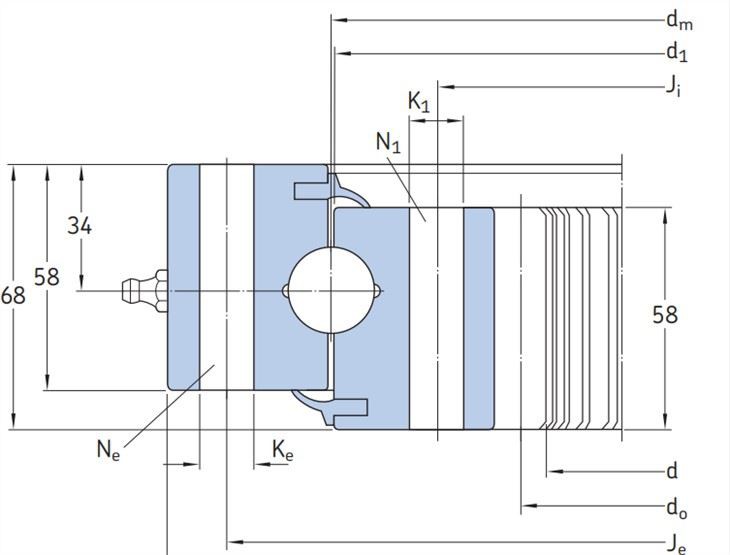
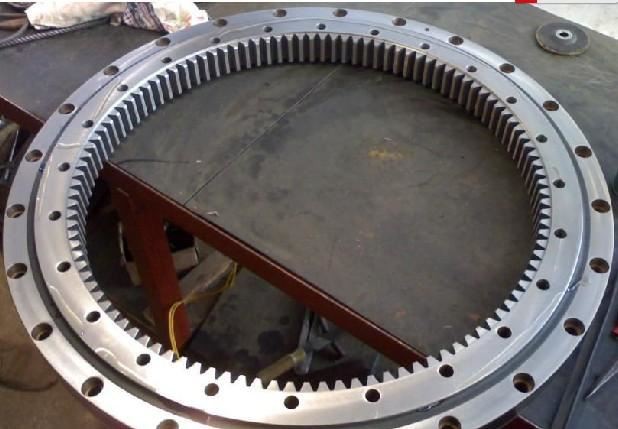
The design of the slewing bearing also matters. Bearings with a larger cross - section or more contact points between the rolling elements and the raceways tend to be stiffer. For instance, a four - point contact ball slewing bearing has a unique design that allows for high load - carrying capacity and good stiffness. You can check out our RKS.302070202001 - Four - point Contact Ball Slewing Bearings With An External Gear. This type of bearing is designed to handle both radial and axial loads effectively, and its stiff structure contributes to high precision in operation.
Manufacturing Process
The way the bearing is manufactured can have a big impact on its stiffness and precision. Precision machining processes ensure that the dimensions of the bearing are accurate and that the surface finish is smooth. For example, a bearing with a well - machined raceway can reduce friction and wear, which in turn helps to maintain the bearing's stiffness and precision.
Lubrication
Proper lubrication is essential for both stiffness and precision. Lubricants can reduce friction between the rolling elements and the raceways, which helps to prevent wear and tear. This keeps the bearing in good condition and ensures that it can operate with high precision. Moreover, a well - lubricated bearing can also handle loads more effectively, contributing to its overall stiffness.
Now, let's talk about some real - world examples of how stiffness and precision work together in our products.
Our RKS.21 0411 - Light Series Slewing Bearings are designed with a focus on both stiffness and precision. These bearings are made from high - quality materials and are manufactured using advanced processes. They are suitable for applications where space is limited but where precision and stiffness are still required. The light - weight design doesn't compromise on performance, and they can provide accurate rotation and positioning.
Another example is our ZARN75155 - TV Needle Roller/axial Cylindrical Roller Bearings ZARN, Double Direction. These bearings are known for their high stiffness due to the unique combination of needle rollers and axial cylindrical rollers. The double - direction design allows for efficient load distribution, which in turn enhances the precision of the bearing.
In conclusion, stiffness and precision are two intertwined characteristics of slewing bearings. A high - stiffness bearing is more likely to offer high precision, and both are essential for the proper functioning of many industrial applications.
If you're in the market for slewing bearings and are looking for products that offer the right balance of stiffness and precision, don't hesitate to reach out. We're here to help you find the perfect bearing for your specific needs. Whether you're working on a small - scale project or a large - scale industrial application, we've got the expertise and the products to support you.
References
- Harris, T. A., & Kotzalas, M. N. (2007). Rolling Bearing Analysis. Wiley.
- Stachowiak, G. W., & Batchelor, A. W. (2005). Engineering Tribology. Elsevier.


