


Hey there! As a thrust bearings supplier, I've seen firsthand how crucial these little components are in various industries, especially in pumps. So, let's dive into what the role of thrust bearings in a pump is all about.
What Are Thrust Bearings Anyway?
Before we get into the pump stuff, let's quickly talk about what thrust bearings are. Thrust bearings are designed to handle axial loads, which are forces that act parallel to the shaft. Unlike radial bearings that deal with loads perpendicular to the shaft, thrust bearings are all about those pushing or pulling forces along the shaft's length.
There are different types of thrust bearings, like ball thrust bearings, roller thrust bearings, and spherical thrust bearings. Each type has its own unique features and is suited for different applications. For example, ball thrust bearings are great for high - speed applications with relatively light loads, while roller thrust bearings can handle much heavier loads.
The Role of Thrust Bearings in a Pump
Axial Load Management
One of the primary roles of thrust bearings in a pump is to manage axial loads. Pumps generate a lot of forces as they move fluids. These forces can create axial loads on the pump shaft. Without proper thrust bearings, these loads could cause the shaft to move axially, leading to misalignment and potential damage to the pump components.
For instance, in a centrifugal pump, the impeller rotates at high speeds to create pressure and move the fluid. This rotation can generate axial forces due to the pressure difference across the impeller. Thrust bearings are installed to counteract these forces and keep the shaft in its proper position. If the thrust bearings fail, the shaft can move axially, causing the impeller to rub against the pump casing, which can lead to wear and tear, reduced efficiency, and even pump failure.
Shaft Support and Stability
Thrust bearings also provide support and stability to the pump shaft. They help keep the shaft centered and prevent it from wobbling or vibrating excessively. This is important because excessive vibration can not only damage the bearings themselves but also other pump components, such as seals and couplings.
In a multistage pump, where multiple impellers are stacked on a single shaft, the thrust bearings play an even more critical role. The combined axial forces from all the impellers can be quite large, and the thrust bearings need to be able to handle these forces to maintain the stability of the shaft. If the shaft is not stable, it can cause uneven wear on the impellers and other internal components, reducing the pump's overall performance and lifespan.
Efficiency and Performance
Properly functioning thrust bearings can significantly improve the efficiency and performance of a pump. By managing the axial loads and providing shaft stability, they reduce friction and wear within the pump. This means that the pump can operate more smoothly and with less energy consumption.
When a pump has well - maintained thrust bearings, it can achieve its design flow rate and pressure more effectively. On the other hand, if the thrust bearings are worn or damaged, the pump may experience a drop in performance, such as reduced flow rate or pressure, which can have a negative impact on the entire system that the pump is part of.
Types of Thrust Bearings Used in Pumps
Angular Contact Thrust Ball Bearings
Angular contact thrust ball bearings are commonly used in pumps, especially those with relatively light to moderate axial loads and high - speed requirements. These bearings can handle both axial and some radial loads. They are designed with a contact angle that allows them to efficiently transmit axial forces.
For example, the Bearing 7602045 - TVP is a great option for pumps where high - speed operation and precise axial load management are needed. Its design ensures smooth rotation and reliable performance, even under challenging conditions.
Cylindrical Roller Thrust Bearings
Cylindrical roller thrust bearings are ideal for pumps with heavy axial loads. They can handle much larger loads compared to ball thrust bearings. These bearings have cylindrical rollers that are arranged parallel to the shaft, which allows them to distribute the load evenly over a larger surface area.
The TA4026VC3 - Cylindrical Roller Bearings are a popular choice for pumps in industrial applications where heavy - duty performance is required. They can withstand high axial forces and provide long - lasting service, even in harsh environments.
Spherical Roller Thrust Bearings
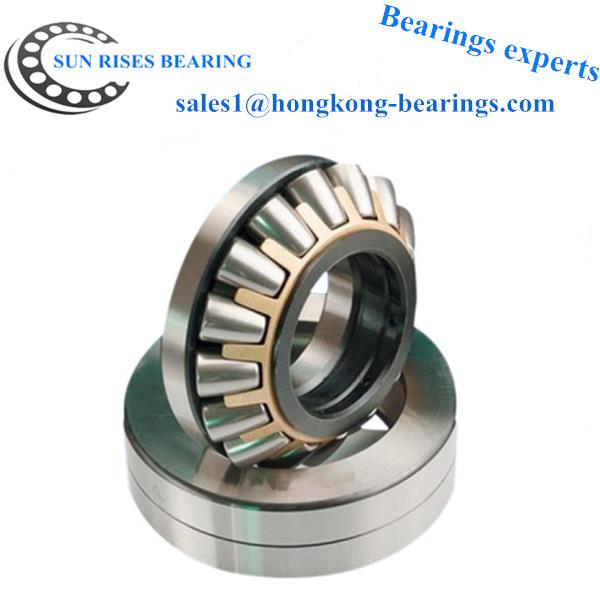
Spherical roller thrust bearings are used in pumps where there may be some misalignment or shaft deflection. These bearings have a spherical raceway that allows them to self - align, which helps compensate for any misalignment between the shaft and the housing.
The 29418E Bearings are well - suited for pumps in applications where the operating conditions may cause some degree of misalignment. They can handle both axial and radial loads and provide reliable performance even when the shaft is not perfectly aligned.

Maintenance and Replacement of Thrust Bearings in Pumps
Proper maintenance of thrust bearings is essential to ensure the long - term performance of the pump. Regular inspections should be carried out to check for signs of wear, such as excessive play, noise, or heat generation. Lubrication is also crucial, as it reduces friction and wear between the bearing components.
If the thrust bearings show signs of significant wear or damage, they should be replaced promptly. Using high - quality replacement bearings is important to ensure the continued reliability and performance of the pump. As a thrust bearings supplier, I can provide you with a wide range of high - quality bearings that are suitable for different pump applications.
Conclusion
In conclusion, thrust bearings play a vital role in pumps. They manage axial loads, provide shaft support and stability, and improve the efficiency and performance of the pump. Choosing the right type of thrust bearings for your pump is crucial, and proper maintenance is essential to ensure their long - term performance.
If you're in the market for thrust bearings for your pump or have any questions about which bearings are right for your application, don't hesitate to reach out. I'm here to help you find the best solutions for your needs. Let's get your pumps running smoothly and efficiently with the right thrust bearings!
References
- "Pump Handbook" by Igor J. Karassik et al.
- "Mechanical Design of Machine Elements and Machines: A Failure Prevention Perspective" by Robert C. Juvinall and Kurt M. Marshek.


