


Hey there! As a supplier of deep groove ball bearings, I've seen firsthand how crucial it is to optimize these little guys for specific applications. In this blog, I'll share some tips and tricks on how to do just that.
First off, let's talk about what deep groove ball bearings are. They're one of the most common types of bearings out there, used in a wide range of applications from electric motors to automotive transmissions. These bearings consist of an inner ring, an outer ring, a set of balls, and a cage to keep the balls in place. They're designed to handle both radial and axial loads, making them versatile and reliable.
Now, when it comes to optimizing the design of deep groove ball bearings for specific applications, there are several factors to consider. Let's dive into each of them.
Load Requirements
The first thing you need to think about is the load requirements of your application. How much weight or force will the bearing need to support? Is it a primarily radial load, an axial load, or a combination of both? Understanding the load requirements is crucial because it will determine the size, material, and internal design of the bearing.
For example, if you're dealing with a high radial load, you might need a larger bearing with a higher load capacity. On the other hand, if you have a significant axial load, you may want to consider a bearing with a special design that can handle that type of force more effectively. Some bearings are also designed to handle both radial and axial loads simultaneously, which can be a great option for applications where you have a combination of forces.
Speed and Lubrication
Another important factor is the speed at which the bearing will operate. High-speed applications require bearings that are designed to minimize friction and heat generation. This often means using special materials, coatings, and lubricants.
Lubrication is key when it comes to high-speed bearings. It helps reduce friction, prevent wear, and dissipate heat. There are different types of lubricants available, such as grease and oil, and the choice depends on the application. Grease is a popular choice for many applications because it's easy to apply and provides long-lasting lubrication. However, for very high-speed applications, oil lubrication may be necessary.
Environmental Conditions
The environment in which the bearing will operate also plays a significant role in its design. If the bearing is going to be exposed to dirt, dust, moisture, or chemicals, it needs to be protected. This can be achieved through the use of seals and shields.
Seals are designed to keep contaminants out of the bearing and retain the lubricant inside. There are different types of seals available, such as contact seals and non-contact seals. Contact seals provide better protection but can also increase friction, while non-contact seals offer less protection but lower friction.
Shields, on the other hand, are used to provide some level of protection against larger particles. They're typically made of metal and are less effective at keeping out small contaminants compared to seals.
Precision and Tolerance
The precision and tolerance requirements of your application are also important. Some applications, such as precision machinery or high-performance engines, require bearings with very tight tolerances. This means that the dimensions of the bearing need to be within a very narrow range to ensure proper operation.

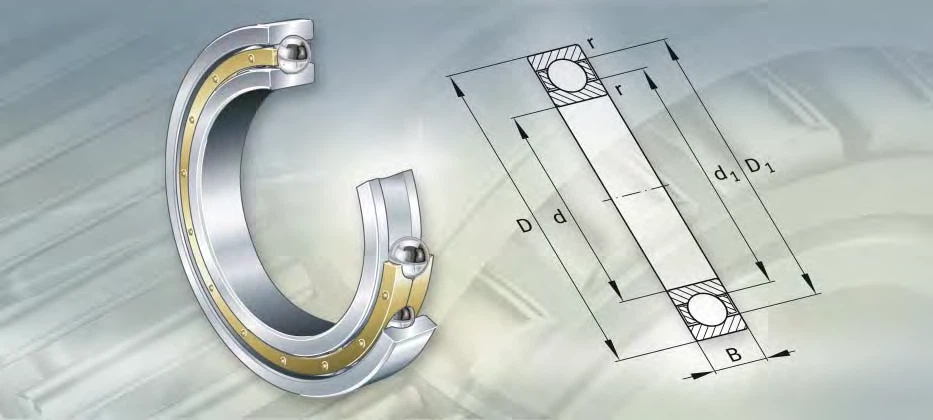
When choosing a bearing, make sure to check the manufacturer's specifications for precision and tolerance. You may also want to consider using a bearing with a higher grade of precision if your application demands it.
Material Selection
The material used to make the bearing is another critical factor. Most deep groove ball bearings are made of steel, but there are different types of steel available, each with its own properties. For example, high-carbon chromium steel is a popular choice because it offers good hardness, wear resistance, and fatigue strength.
In some cases, you may need to use a different material, such as ceramic or stainless steel. Ceramic bearings are lightweight, have a high hardness, and are resistant to corrosion, making them suitable for high-speed and high-temperature applications. Stainless steel bearings, on the other hand, are resistant to rust and corrosion, making them a good choice for applications in wet or corrosive environments.
Application-Specific Design Features
In addition to the general factors mentioned above, there may be some application-specific design features that you need to consider. For example, if you're using the bearing in a motor, you may want to look for a bearing with a low noise level. Or, if you're using it in a conveyor system, you may need a bearing that can handle misalignment.
Let's take a look at some of our products that are designed for specific applications. We have the 619/750-MB-C3 Single Row Deep Groove Ball Bearing, which is suitable for a variety of applications where moderate loads and speeds are involved. This bearing offers good performance and reliability.
Our 160/1060-M With Single Row Deep Groove Ball Bearing is another great option. It's designed to handle specific load requirements and is a popular choice for many industrial applications.
And if you're looking for a bearing that's in stock and ready to go, our 6368-M-C3 Single Row Deep Groove Ball Bearing Are In Stock is a great choice. It offers high performance and is suitable for a wide range of applications.
Conclusion
Optimizing the design of deep groove ball bearings for specific applications is all about understanding the requirements of your application and choosing the right bearing with the appropriate features. By considering factors such as load requirements, speed, lubrication, environmental conditions, precision, and material selection, you can ensure that your bearing will perform at its best and last for a long time.
If you're in the market for deep groove ball bearings and need help choosing the right one for your application, don't hesitate to reach out. We're here to assist you in finding the perfect bearing solution. Contact us for more information and to start the procurement process. We look forward to working with you!
References
- "Bearing Handbook" by SKF
- "Mechanical Design Handbook" by CRC Press


